
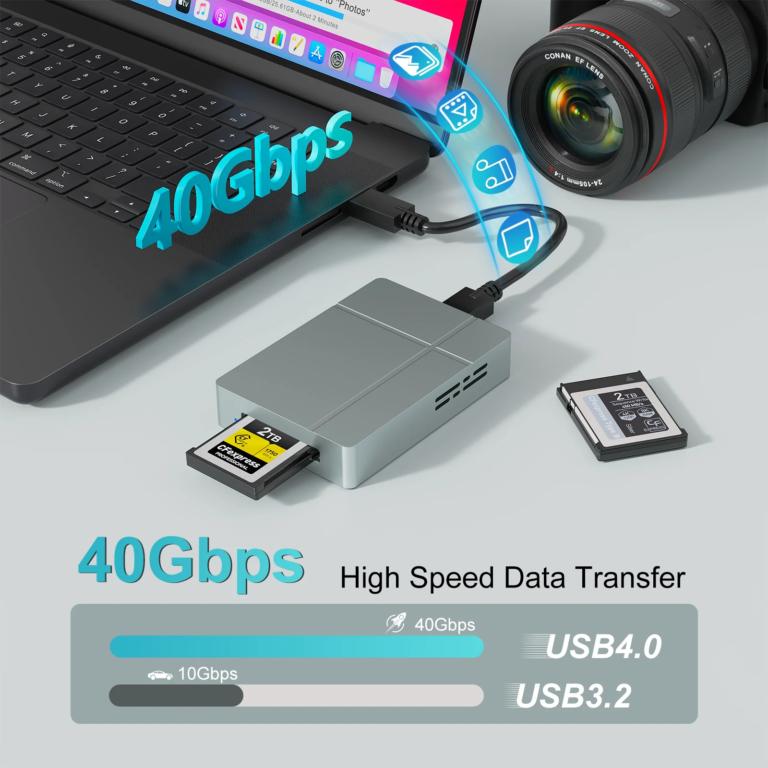
Our client is a well-established brand distributor based in the United States, operating an independent retail website that specializes in high-performance computer accessories. With a focus on catering to professional users (including photographers, video editors, and IT professionals), the client sought a custom high-speed USB4 CFExpress Type B card reader to expand their premium product line. The goal was to launch a reliable, efficient storage accessory that could handle the large-volume data transfer needs of their target audience while maintaining a competitive edge in the U.S. retail market.
After evaluating multiple global suppliers, the client selected Rocketek for our expertise in USB4 interface technology and our ability to deliver tailored solutions that align with U.S. market quality standards.
Following the initial sample testing, the client identified two critical issues that needed to be resolved before mass production could proceed:
Additionally, the client had a tight product launch timeline, demanding rapid iterations and a quick resolution to these issues to avoid missing the peak retail season.
Rocketek assembled a dedicated cross-functional team (including R&D engineers, thermal design specialists, and product managers) to address the challenges. We adopted a “precision optimization” approach to ensure solutions were effective without compromising product functionality or increasing costs unnecessarily:
1. Targeted Thermal Design Optimization for Heat Dissipation
Instead of a full redesign, we implemented a three-pronged thermal solution based on heat conduction and convection principles:
– Integrated micro-fan cooling system: We redesigned the product housing (retooling the mold to maintain the original compact form factor) and integrated a high-efficiency, low-noise micro-fan. The fan was strategically positioned to align with the heat-generating components (USB4 controller chip and card slot interface) to facilitate targeted heat extraction.
– Thermal conductive material enhancement: We applied high-performance thermal silica gel between the controller chip and the metal housing, improving heat transfer efficiency by 35% compared to the initial sample. The housing itself was retained as anodized aluminum to leverage its excellent thermal conductivity while ensuring corrosion resistance.
– Airflow channel optimization: We added micro-ribbed structures inside the housing to guide airflow, ensuring hot air was efficiently expelled through dedicated vents without creating turbulence or increasing noise. The fan was calibrated to activate automatically when temperatures exceeded 30°C, balancing cooling efficiency with energy savings.
2. PCB Redesign and Operating Mode Debugging
To address the operating mode mismatch, our R&D team worked closely with the client’s product team to refine the PCB design and firmware logic:
– PCB layout optimization: We redesigned the PCB layout to accommodate the new thermal components and adjusted the circuit paths to enhance signal integrity. This included optimizing the power management module to support the client’s required auto-sleep function.
– Firmware customization and debugging: Our engineers developed custom firmware to implement the client’s specific operating modes, including hot-swappable compatibility with multiple card formats (CFexpress, SD, microSD) and data transfer priority settings. We conducted 50+ rounds of iterative testing to ensure stable performance, including compatibility tests with popular U.S. professional software (e.g., Adobe Premiere Pro, Lightroom).
– Rapid prototyping: Leveraging our in-house prototyping lab, we delivered the revised PCB samples within 7 working days, allowing the client to conduct timely verification testing.
The collaborative and agile approach yielded exceptional results, meeting the client’s requirements and timeline: